American Minotaur: Chuck Klosterman’s Rock* and the Eeriness of Criticism
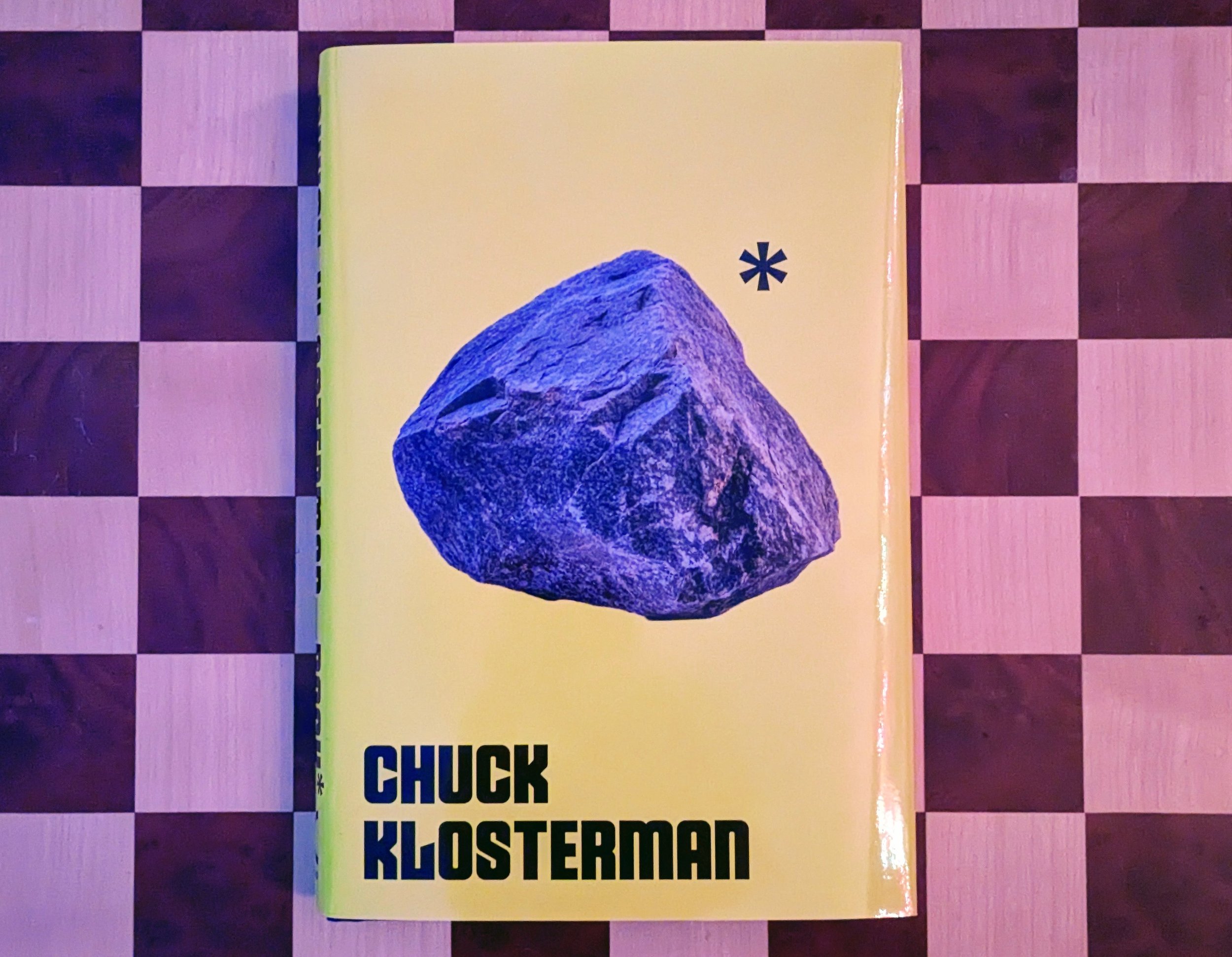
Chuck Klosterman’s Rock* is not a horror novel, but it is horrific (complementary).
Fictional Nonfiction
Rock*: A Mainstream Alternative History of Alternative Mainstream Music—the latest book from culture critic and novelist Chuck Klosterman—is difficult to describe. On the surface, it’s a work of speculative fiction, chronicling a version of the late 20th century that never happened: a timeline in which the 1967 release of The Velvet Underground & Nico immediately unseated the Beatles as the center of popular culture. But I’m not sure that summary does it justice. Rock* is a dystopian science fiction novel and a work of historical satire. It’s a piece of real criticism and a commentary on criticism itself. It’s a stealth endorsement of Steely Dan’s perfectly-rated place in our culture. It’s a 304 page 9/11 joke. It’s the culmination of the author’s entire philosophical bibliography distilled into a single experimental narrative. But more than all of that, Rock* is a masterpiece of weird fiction. And that’s why I’m writing about it on this horror blog.
My favourite thing about horror is its emergent quality. While it is a genre unto itself, with conventions and tropes and canons, horror is ultimately defined by a feeling that seeps out of elements within a story that aren’t necessarily scary on their own. Sure, there’s the overtly frightening, terrible, and nightmarish stuff, but most sources of the horrific are subtle. The strange and the uncanny, the disturbing and violent, the gothic and campy—none of these are solely horrific, but pile up enough misshapen stones and they start to look like a demonic altar. That’s how horror can be found in so many unexpected places. There are horrific songs, there are horrific children’s stories, even horrific television commercials. And through Klosterman’s Rock* we can see how criticism is horrific, too. Rock* is not a horror novel, but it fully embodies two of its most prominent ingredients, the weird and the eerie. And its weirdness starts on a physical level.
In Mark Fisher’s seminal 2017 book The Weird and the Eerie, the late music critic and cultural theorist wrote: “...a weird entity or object is so strange it makes us feel it should not exist, or at least it should not exist here.” And that is the feeling I have when I hold Rock* in my hands. The actual book itself feels simultaneously real and unreal. It has no dedication or acknowledgements section, and while the text is full of dramatic irony and winking jokes, those rely on the reader’s familiarity with real mainstream music, film, and US political history. If you were to scratch out the subtitle and rip out the obligatory notice in the frontmatter stating that Rock* is a work of Klosterman’s imagination, then give the book to a person who doesn’t know when John Lennon died or how acceptable recreational heroin use was in the previous century, they would have no reason to believe they were reading fiction.
The straight-faced presentation of Klosterman’s alternate history gives it an air of the abominable. I am not used to holding an object that’s filled with such confident analysis of events that didn’t happen. In our time of widespread propaganda, when the dismantling of digital information sharing infrastructure makes history feel so unreliable, the believable presentation of Rock* feels almost like an act of violence. We are constantly defending ourselves against misinformation in our daily lives, so having a trusted critical voice tell you Bowie’s final studio album was Station to Station is an epistemological haymaker. None of this happened, but it’s right here in this book.
Sex, Drugs and Something Else
As a physical book, Rock* is weird, but its contents are an exercise in the eerie. According to Fisher, “The sensation of the eerie occurs either when there is something present where there should be nothing, or there is nothing present when there should be something.” And that’s the engine under Rock*’s hood. By reconfiguring the popularity of one band, Klosterman traces a history that never happened, in which some things that should be present go missing, and other things become present to fill in the gaps.
The uncanny super popularity of The Velvet Underground & Nico (which I think might have been caused by a cosmic ray blast described on page 17) is the first impossible presence. It’s the splash in the cultural timeline, creating ripples that will turn to tidal waves. The Velvet Underground’s ascendence leads to the creation of an alternate version of Rolling Stone magazine called Velveteen, which is the in-universe publisher of Rock*. Andy Warhol becomes a super producer, John Lennon gets addicted to Twix bars, and the social acceptance of heroin is partially blamed for the voter apathy responsible for 35 years of fascist Republican rule.
In Klosterman’s Velveteen Universe, the National Association of Rock Critics (NARC) emerges as a powerful cartel that’s able to force rock music into every aspect of American life, even sci-fi movies like Star Wars. MTV becomes the political music channel ROCKSPAN and a massive wall of speakers is erected in Nevada, perpetually blaring guitar-forward pop tunes. Prince wins an Oscar for playing Hannibal Lecter in The Silence of the Lambs. These things feel eerie because I know they shouldn’t be there in history, and yet they are, presented with unflinching deadpan. But that’s par for the course with speculative fiction.
What’s more eerie is what’s not in Rock*. Early in the book, it becomes apparent that popularity is a loadbearing force. As the careers of canonical rockstars fizzle, their later works fail to materialize along with their cultural impact. This is a universe where Led Zeppelin failed to take off, where Kiss was literally annihilated in a fireball after recording only one album, and where Lou Reed was shot to death by Mark David Chapman (assassinated by our Beatle-killer before he could record with Gorillaz, Metric, and crucially Metallica). The absence produced in me a strange feeling of grief, mourning the erasure of beloved music from someone else’s life.
This eerie aspect brings out an ironic form of criticism in Rock*. By writing about the fake actions of real bands, Klosterman is critiquing real music history apophatically. The more egregious the historical violation, the more eerie the narrative becomes, and the more the book points to what really happened without spelling it out. This is most effectively demonstrated by the complete absence of Nirvana and Kurt Cobain. By the time the narrative gets to the ‘90s, the butterfly effect has gotten so intense that the closest thing to a line about the most important band of that decade is a sentence referencing the work of feminist academic Dr. Courtney Love. The words “Cobain” and “Nirvana” are missing from the index, and by leaving them out, Klosterman summons their ghosts to haunt the final act of Rock* like teen spirits.
I Wear the Minotaur’s Cap
While the artists written about in the last third of Rock* remain recognizable as the musicians we all remember from the 90s and early 2000s, they are not the people we know them to be in our reality. They mean something else. They express themselves differently. And their music takes on an alien aspect, with slightly different titles, alternate release dates, and different influences. The world is drowning in music by artists I know—from R.E.M., Yo La Tengo, and Uncle Tupelo to Oasis, The White Stripes, and The Strokes—but I can’t imagine what it sounds like. At this point, the book becomes a piece of criticism about art I can’t experience. I have no ears, so I must read. But that’s okay. That’s actually how it always works.
It is possible, if reductive, to describe Rock* as a novel. And in this sense, it has a lot in common with Klosterman’s previous works of fiction, which are each speculative and horrific in their own ways, but also function as demonstrations of ideas first expressed in his essay collections and memoirs. Rock* explores many ideas from his nonfiction—the nature of popularity, how present events reframe the ways we perceive the past, the role of authenticity in art and entertainment, the comedic nature of Metallica in therapy—but more than anything he’s written, this book feels like an embodiment of the core truth the author has come to represent over fourteen books. That truth is this: criticism can be elevated to an artform, and at the level of art, criticism stands independent of its subject.
Kosterman was the critic that convinced me to be a writer. I was seventeen years old when I picked up someone else’s copy of Sex Drugs and Cocoa Puffs and read it cover to cover. I’d never seen a minute of The Real World, I’d never heard a note of Billy Joel outside of “Piano Man,” and the only thing I knew about the movie Vanilla Sky was that Tom Cruise was in it and my parents hated it. But every argument in that essay collection made sense, every joke landed, and I absorbed all the meaning. I’m not unique in this. I imagine most unserious millennial men who write professionally about culture had the same experience and learned the same lesson. Criticism tells you why its subject is important independently of that subject. And that’s how criticism is always eerie; criticism never contains the experience that allows it to exist.
In podcast interviews, Klosterman has said his original title for Sex, Drugs and Cocoa Puffs was American Minotaur. His publisher changed it. I think about this a lot. How the unused title feels more monstrous and heavy and associated with deep time. It makes me think of a bull-headed man, angry and trapped, possibly from Greece originally but he has a green card. And obviously it makes me think of a labyrinth—the maze structure built to contain the beast. When I think about the alternate title, I think about an alternate me, who set out as a critic inspired by the image of a mythical creature instead of vice and cereal.
When parsing the minotaur metaphor, I used to think art was the bullman: a combination of old and new, a balance of animal passion and human faculty. But now, after reading Rock*, I understand it’s us. We are the ones trapped in ever-shifting walls of discourse that define the terms of our world. It doesn’t matter if we know the subject or even if it’s real. No matter what universe we’re in, we don our horns and hunt the maze for authenticity. We wear the minotaur cap.